
"What's a roof cleaning lead going to cost me?" It is usually the first question a roofer or exterior cleaner asks, and it is a fair one. It is also the question nobody can answer honestly with a single number.
Anyone who tells you a roof cleaning lead costs a fixed amount is either quoting someone else's account or selling you something. What we can do is show you how that cost is made up, and how to work out what a lead is worth to you.
First, be clear what you mean by a "lead"
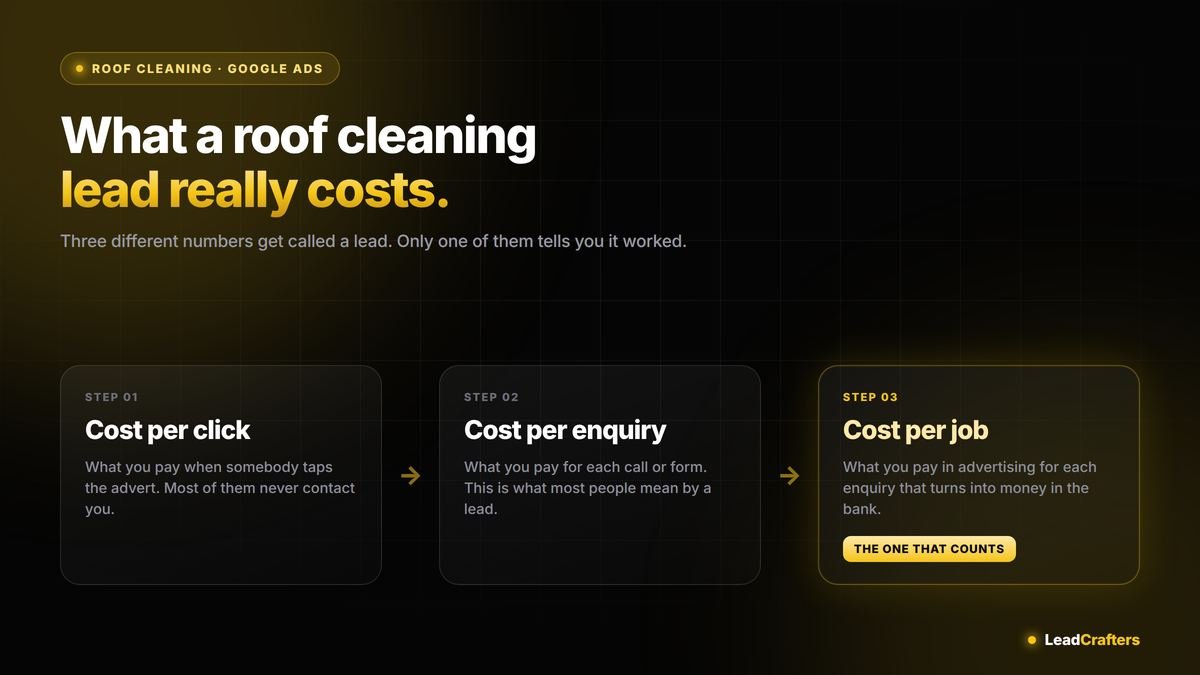
Half the confusion in this conversation comes from three different things sharing one word. There are really three numbers, and they are not interchangeable:
- Cost per click — what you pay when somebody taps your advert. Most of them will never contact you.
- Cost per enquiry — what you pay for each person who actually rings, fills in the form or messages you. This is what most people mean by a lead.
- Cost per job — what you pay in advertising for each enquiry that turns into money in the bank.
The last one decides whether advertising is working for you. A cheap click means nothing if the phone never rings, and a cheap enquiry means nothing if it never books. When someone quotes you a cost per lead, ask which of the three they mean.
Why the number moves around so much
Roof cleaning is not one market. The cost of getting in front of someone changes with all of the following:
- Where you work. A dense city with a dozen firms bidding on the same searches is a different market to a rural patch with two.
- The time of year. Demand for roof and moss work is seasonal, and so is the competition for it.
- The job itself. Somebody searching for moss removal on a terrace is not worth the same to you as somebody with a large detached roof wanting a full softwash.
- How urgent it is. Urgent searches tend to be more expensive and also more likely to book.
- Who else is bidding that week. This changes constantly and is outside anybody's control.
- How good your advert and your page are. Two firms bidding the same money on the same search can end up paying very different amounts per enquiry.
That last point is worth sitting with. A large part of your cost per lead is not set by the market. It is set by how your advertising is put together and how you handle what comes through.
Work out what you can afford to pay
Rather than asking what a lead costs, ask what one is worth to you. You already have the figures for this — nobody else does.
Take your average roof cleaning job value. Take off materials, labour and your travel, so you are left with what the job puts in your pocket. Then think about how many quotes you have to give to win one job. If roughly one in three of your quotes turns into work, then three enquiries is what a job costs you — so the most you can pay per enquiry is a third of what a job is worth, and comfortably less than that if you want to make money on it.
That is arithmetic, not a promise, and the numbers are yours to fill in. But it turns a vague worry into a ceiling: above this figure per enquiry, it is not worth doing; below it, it is.
One thing that catches people out: a roof cleaning customer often has a drive, gutters and fascias too. If a job frequently turns into two jobs, the enquiry was worth more than the first invoice suggests — but be honest about how often that really happens.
What pushes the cost up
Most expensive roof cleaning advertising is expensive for ordinary, fixable reasons:
- Broad keywords catching searches for roof repairs, new roofs, roofers wanted and people looking for work
- No negative keyword list, so you pay for "roof cleaning jobs", "how to clean a roof yourself" and similar
- One campaign covering roofs, gutters, drives and windows, so you cannot see or control what any of it costs
- Clicks landing on a homepage rather than a page about the actual job they searched for
- Adverts running well outside the area you would genuinely travel to
- Enquiries sitting unanswered for hours while somebody else rings them back first
- No call tracking, so nobody knows which enquiries came from advertising at all
What brings it down
The opposite, mostly. Tight keywords with a proper negative list. A separate campaign for roof work so its numbers stand on their own. A page about roof cleaning, with your own before and after photos on it. A sensible radius. Reviews that make you the obvious choice among three quotes. And answering quickly — speed of reply changes your cost per job more than almost anything else, because the enquiry is already paid for by then.
If you want the detail on how the campaign side of that is built, our page on Google Ads management for trades walks through it, and there is more on this trade specifically on our roof cleaning leads page.
Cheap leads are not the goal
It is tempting to judge everything on cost per enquiry, because it is the easiest number to see. But you can drive that number down by advertising to people who were never going to spend much, and end up busier, poorer and more tired. A dearer enquiry from somebody with a large roof who wants it doing this month beats three cheap enquiries from people ringing round for a price. Judge the money by the jobs it produced, not by the count of phone calls.
When this is not for you
Worth saying plainly, because it is true more often than the advertising industry admits:
- If you are already booked out for months, spend the money on another van or another pair of hands instead.
- If nobody can answer the phone during the working day and there is no one to take messages, paid advertising will mostly buy missed calls.
- If your average job is small and your margin is thin, the ceiling you worked out above may simply be too low to bid into a competitive area.
- If you cannot leave a budget running for long enough to gather real numbers, you will be making decisions on noise.
- If you are not willing to track where enquiries come from, you will never know whether it worked, and neither will anyone else.
None of that means avoiding advertising forever. It means fixing what is in the way first.
How to find your own number
Track calls and form submissions so each one is attributed to a source. Write down what each enquiry was for and what it was worth if it booked. Review monthly, not daily — daily figures on a small budget will send you round the bend. After a couple of months you will have the only cost per lead figure that means anything: yours.
So what does it cost?
Honestly: it varies enough that a headline figure would mislead you. What does not vary is the method. Work out what a job is worth to you, work out your ceiling per enquiry, get the campaign tight enough that you only pay for people who want the work you do, then answer quickly and measure what books.
If somebody runs your advertising and cannot tell you your cost per enquiry and your cost per job, that is the problem to solve before you worry about the price of a click. Always ask for current figures directly rather than relying on an average you read somewhere.
We will go through your own numbers with you on a free call, and tell you straight if paid advertising is not the right fit for where your business is right now.
Leave a Reply